
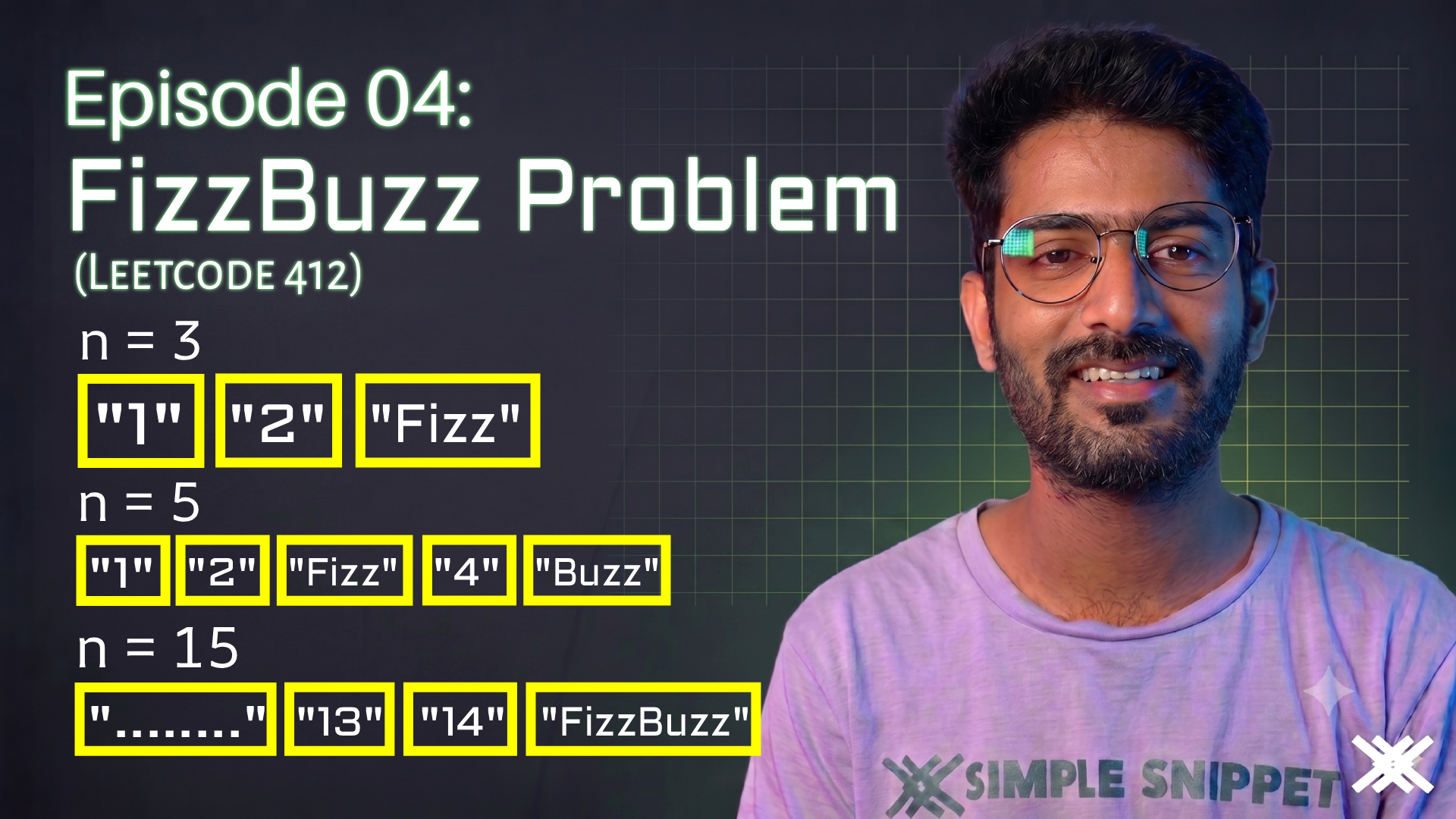
Welcome to Episode 5 of our Competitive Programming for Beginners Challenge! After crushing our first few problems on Codeforces, we are stepping into a brand new arena today: LeetCode.
We are tackling what is arguably the most famous coding interview question in the world: FizzBuzz (LeetCode 412). While it tests basic conditional logic, it contains a notorious trap that fails thousands of candidates in whiteboard interviews. Let’s break down the logic and learn how to navigate LeetCode’s unique coding environment.
The Problem Statement
Given an integer n, return a string array answer (1-indexed) where:
answer[i] == "FizzBuzz"ifiis divisible by 3 and 5.answer[i] == "Fizz"ifiis divisible by 3.answer[i] == "Buzz"ifiis divisible by 5.answer[i] == i(as a string) if none of the above conditions are true.
Input:
A single integer n.
(Constraints: 1 <= n <= 10^4 )
Example:
- Input:
n = 15 - Output:
["1", "2", "Fizz", "4", "Buzz", "Fizz", "7", "8", "Fizz", "Buzz", "11", "Fizz", "13", "14", "FizzBuzz"]
The Logic & Theory Breakdown
Before writing the code, we need to understand two major concepts that trip up beginners on this problem.
1. The “Number 15” Trap (Order of Conditions)
When checking divisibility, the most restrictive condition must always go first.
If you write your code to check if a number is divisible by 3 first, what happens when the loop reaches the number 15? The computer sees that 15 % 3 == 0 is true, prints “Fizz”, and entirely skips the rest of your checks! It will never reach the “FizzBuzz” condition.
To fix this, you must check if the number is divisible by both 3 and 5 (or simply divisible by 15) at the very top of your if/else if chain.
2. What is a C++ Vector?
Unlike Codeforces, where we write a main() function and use cout to print to the screen, LeetCode asks us to complete a specific function and return the data.
Because we don’t know how big $n$ will be ahead of time, we cannot use a standard, fixed-size array. Instead, we use a Vector (vector<string>). Think of a vector as a dynamic, “stretchable” array. We start with an empty vector and use the .push_back() command to stretch the array and add our answers one by one.
C++ Code Implementation
Here is the clean, optimized C++ solution for FizzBuzz, formatted exactly as LeetCode expects it.
#include <iostream>
#include <vector>
#include <string>

using namespace std;

class Solution {
public:
    vector<string> fizzBuzz(int n) {
        vector<string> result; // Create our stretchable array

        // Loop from 1 to n
        for (int i = 1; i <= n; i++) {

            // TRAP AVOIDED: Check the most restrictive condition first!
            if (i % 3 == 0 && i % 5 == 0) {
                result.push_back("FizzBuzz");
            }
            else if (i % 3 == 0) {
                result.push_back("Fizz");
            }
            else if (i % 5 == 0) {
                result.push_back("Buzz");
            }
            else {
                // Convert the raw integer to a string before adding it
                result.push_back(to_string(i));
            }
        }

        return result; // Hand the final array back to LeetCode
    }
};Complexity Analysis
- Time Complexity: O(N) linear time. We are using a single
forloop that runs exactly n times. The operations inside the loop take constant time. - Space Complexity: O(N) linear space. We are creating a vector array of size n to store and return our answers.
Conclusion
Great job! You have successfully solved your first LeetCode problem, learned about C++ Vectors, and avoided the most common logical trap in coding interviews.
If you want to see exactly how to navigate the LeetCode platform and test this code in real-time, watch the full video tutorial below!
Hit the “Join” button on our YouTube channel to become a Snippet Supporter! You’ll get instant access to our downloadable ad-free Master Notes, featuring the complete code and step-by-step logic breakdown so you can confidently review before your placement drives. Link to join our Youtube Channel Simple Snippets : https://www.youtube.com/channel/UCRIWTSgd7hGtZhx4RYoASEg/join